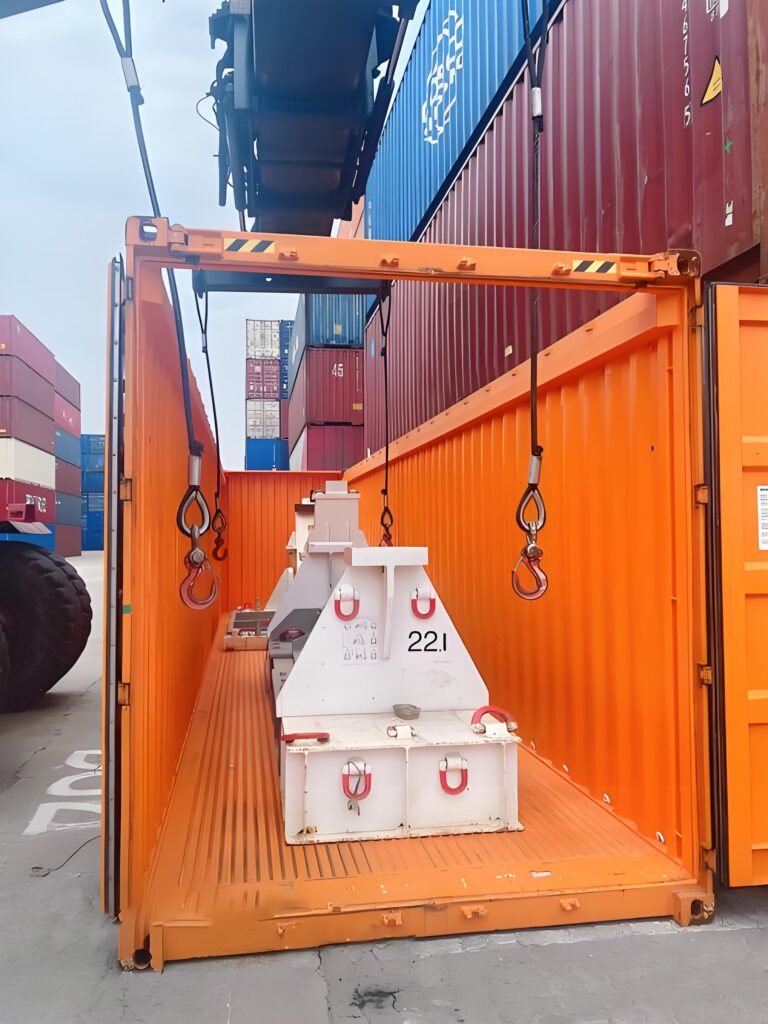
The global supply chain is a tapestry of precision, where a single miscalculation in logistics can unravel timelines and budgets. For businesses tasked with moving heavy machinery—specifically a 22-ton industrial asset—from the manufacturing hubs of Shanghai to the bustling ports of Los Angeles, the choice of equipment and the strategy behind the quote are paramount. This article provides an in-depth analysis of securing a 40-foot Flat Rack (40’FR) quote, moving beyond surface-level pricing to explore the engineering, regulatory, and operational nuances that define a successful shipment.
The Imperative of the Flat Rack: Why Standard Containers Fail
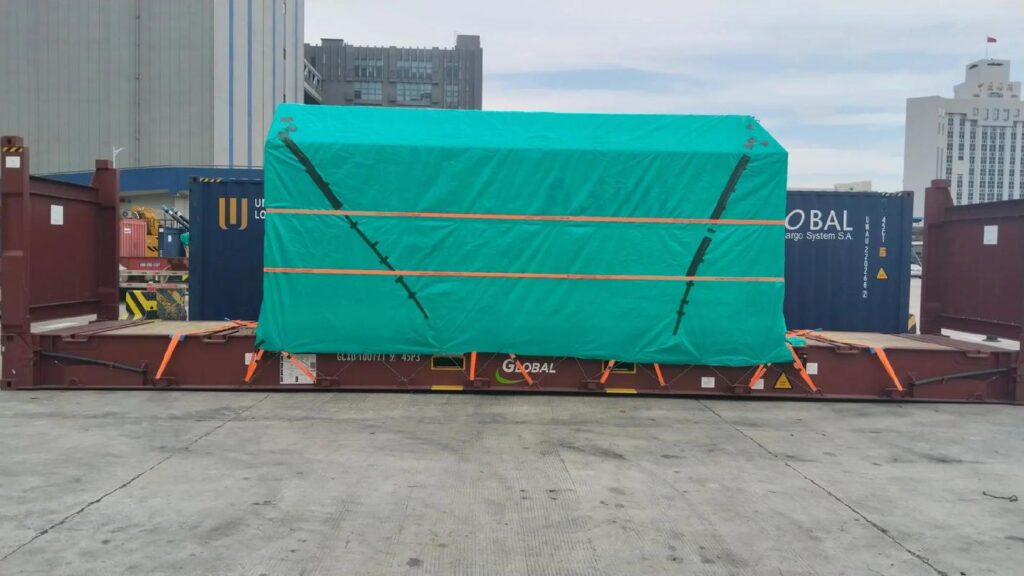
Standard dry containers are the workhorses of maritime trade, but they operate within rigid constraints. A 22-ton piece of machinery often violates at least two of these constraints: weight distribution and dimensional clearance. First, there is the issue of Center of Gravity. A 22-ton mass concentrated in a small footprint creates immense pressure points. Standard container floors are rated for uniform distribution; a heavy machine can buckle the corrugated steel flooring or damage the corner posts. Second, dimensional clearance becomes a challenge. While a 40-foot container offers internal dimensions of approximately 12.03m x 2.35m x 2.39m (LxWxH), machinery often exceeds width or height limits due to protrusions like flywheels, control panels, or lifting lugs. This is where the 40’FR (Flat Rack) becomes indispensable. Unlike standard containers, flat racks are essentially a steel platform with two end walls (bulkheads) that can often be folded flat. They have no side walls or roof, allowing for over-dimensional cargo. Crucially, their floors are constructed with reinforced steel beams designed to handle extreme point loads, making them the only safe option for a 22-ton industrial load.
Deconstructing the Anatomy of a 40’FR Quote
A professional quote for this route is not a single number; it is a composite of several cost centers. Understanding these components allows for better negotiation and budget forecasting.
1. Ocean Freight (Base Rate)
This is the core cost charged by the carrier (e.g., COSCO, Evergreen, Maersk) for transporting the flat rack from Shanghai (typically Port of Shanghai – CNSHA) to Los Angeles (USLGB or USLAX). Rates fluctuate based on the “General Rate Increase” (GRI) cycles, which are typically announced for the first of each month. For a 40’FR carrying heavy machinery, expect the base rate to be significantly higher than a standard 40HC (High Cube) due to the lost opportunity cost for the carrier—your machinery occupies space that could have held multiple TEUs (Twenty-foot Equivalent Units).
2. Bunker Adjustment Factor (BAF) / Fuel Surcharge
This variable surcharge reflects the price of marine fuel. Given the current volatility in energy markets and the increased fuel consumption required to power a vessel carrying heavy, potentially less aerodynamic, flat rack cargo, this component can constitute a substantial portion of the total cost.
3. Terminal Handling Charges (THC)
These are fees levied by the terminal operators at both ends. In Shanghai, export THC for special equipment like flat racks is higher due to the need for specialized handling gear (heavy-duty straddle carriers or cranes). In Los Angeles, import THC is notoriously high, often calculated per “per diem” or based on the size and type of the equipment.
4. Special Equipment Surcharges
Carriers often apply a premium for flat racks because they are a limited resource. Additionally, a Heavy Lift Charge may apply if the cargo exceeds the standard 10-15 ton threshold, which your 22-ton machine certainly does.
5. Inland Haulage (Drayage)
Unless the delivery is to the port itself, you will need a chassis and a truck to move the flat rack from the LA port to the final destination. For a 22-ton load, this requires a tri-axle chassis and a powerful tractor unit, incurring higher drayage rates than standard shipments.
The Criticality of Cargo Securing and Lashing
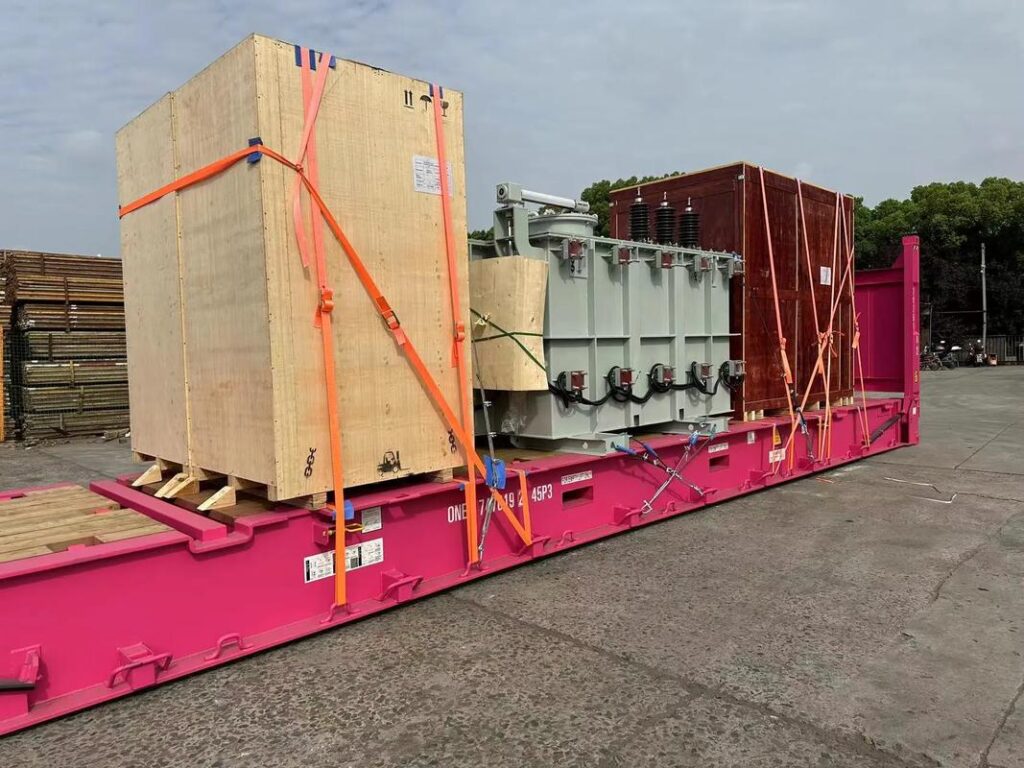
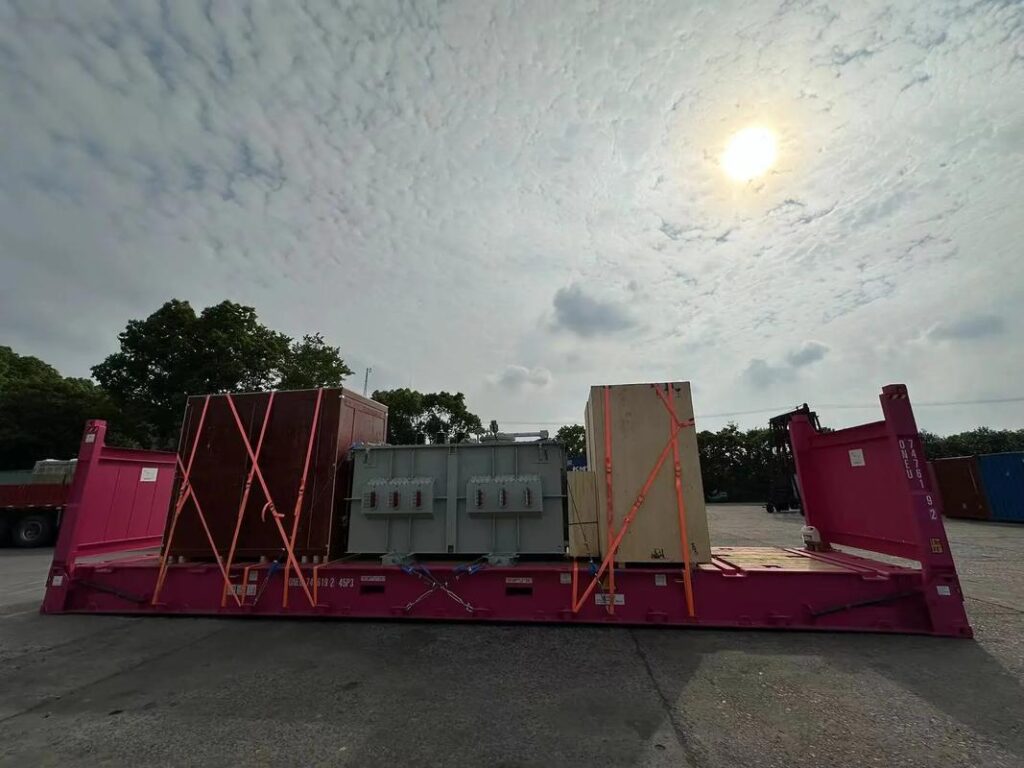
With a 40’FR, the responsibility for cargo integrity shifts heavily onto the shipper. Unlike a closed container where cargo is somewhat protected, a flat rack exposes the machinery to the full violence of the ocean environment—pitching, rolling, and yawing. A 22-ton machine generates tremendous kinetic forces during transit. A sudden stop or a 30-degree roll can turn the machinery into a battering ram. Therefore, the quote must account for professional lashing services. This involves:
- Certified Lashing Materials: Using high-tensile steel wire ropes, heavy-duty chains, or synthetic webbings with verifiable break strengths.
- Engineering Calculation: A lashing plan must be provided, calculating the “Transverse Shift Force” and ensuring the securing points on the flat rack can withstand these forces.
- Wooden Chocking: Solid timber blocks must be wedged between the machine’s base and the flat rack’s floor to prevent lateral movement.
Failure to comply with the Cargo Securing Manual (CSM) standards set by the International Maritime Organization (IMO) can result in the carrier refusing to load the cargo at Shanghai port, leading to costly delays.
Operational Workflow: From Shanghai to Los Angeles
Phase 1: Pre-Shipment Survey
Before requesting a formal quote, conduct a pre-shipment survey. Measure the machinery’s exact dimensions (LxWxH) and its center of gravity. Identify the lifting points and securing points. This data is critical for the carrier to confirm if the flat rack’s payload capacity (usually around 26-28 tons for a 40’FR) is sufficient.
Phase 2: Booking and Permits
Booking a 40’FR requires more lead time than standard containers—ideally 14-21 days in advance. The carrier will require detailed photographs and technical drawings. In Los Angeles, over-dimensional cargo may require special permits for inland transport, especially if the machinery exceeds 8.5 feet in width.
Phase 3: Customs and Documentation
For the US import, the machinery must comply with FDA, DOT, or EPA regulations, depending on its function (e.g., if it contains refrigerants or engines). The ISF (Importer Security Filing) must be filed 24 hours before departure. Any discrepancy in the declared weight versus the actual weight can trigger a “Weight Verification” fine under the SOLAS VGM (Verified Gross Mass) regulations.
Risk Mitigation and Insurance
Standard marine cargo insurance often excludes “improper packing.” Given the complexity of flat rack shipping, it is advisable to obtain “All Risks” coverage with specific endorsements for heavy lift and project cargo. Ensure the insurance value covers not just the machinery cost, but also the freight, duties, and an estimated cost for replacement in case of total loss.
Selecting the Right Logistics Partner
Not all forwarders are equipped to handle 40’FR shipments. When evaluating quotes, look for:
- Equipment Availability: Do they have immediate access to 40’FRs in Shanghai?
- Lashing Certification: Do they provide certified lashing inspectors?
- Port Expertise: Do they have a dedicated team at the Port of Los Angeles to manage the offloading and drayage of heavy equipment?
Conclusion: The True Cost of Precision
Securing a quote for a 22-ton machinery shipment via 40’FR from Shanghai to Los Angeles is an exercise in detail management. The cheapest quote is rarely the best; instead, the most reliable quote is one that transparently accounts for every variable—from bunker surcharges to the tensile strength of the lashing chains. By investing in expertise and robust planning, businesses can ensure their valuable assets arrive safely, on time, and without the financial hemorrhage of unforeseen penalties or damages.


