
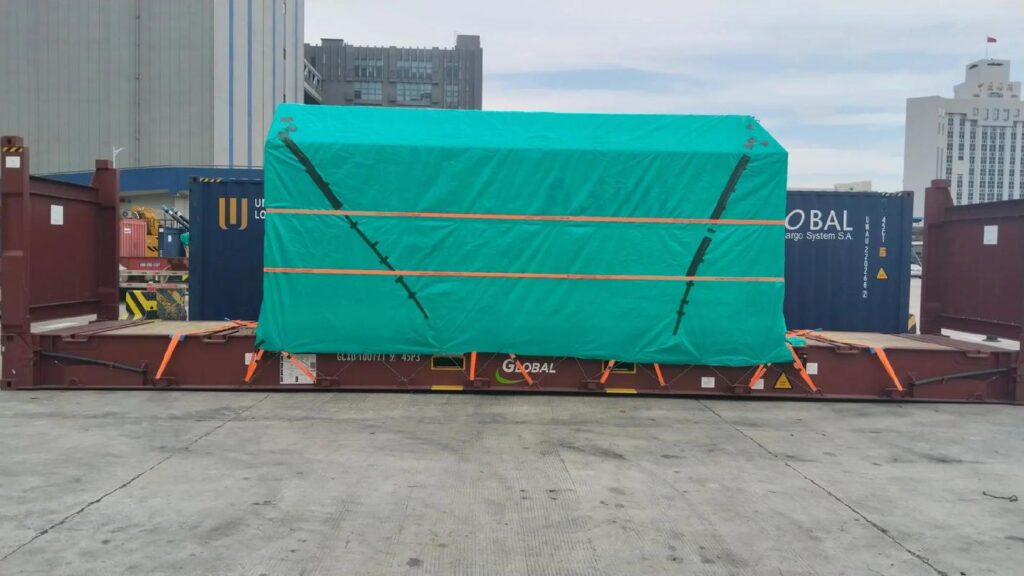
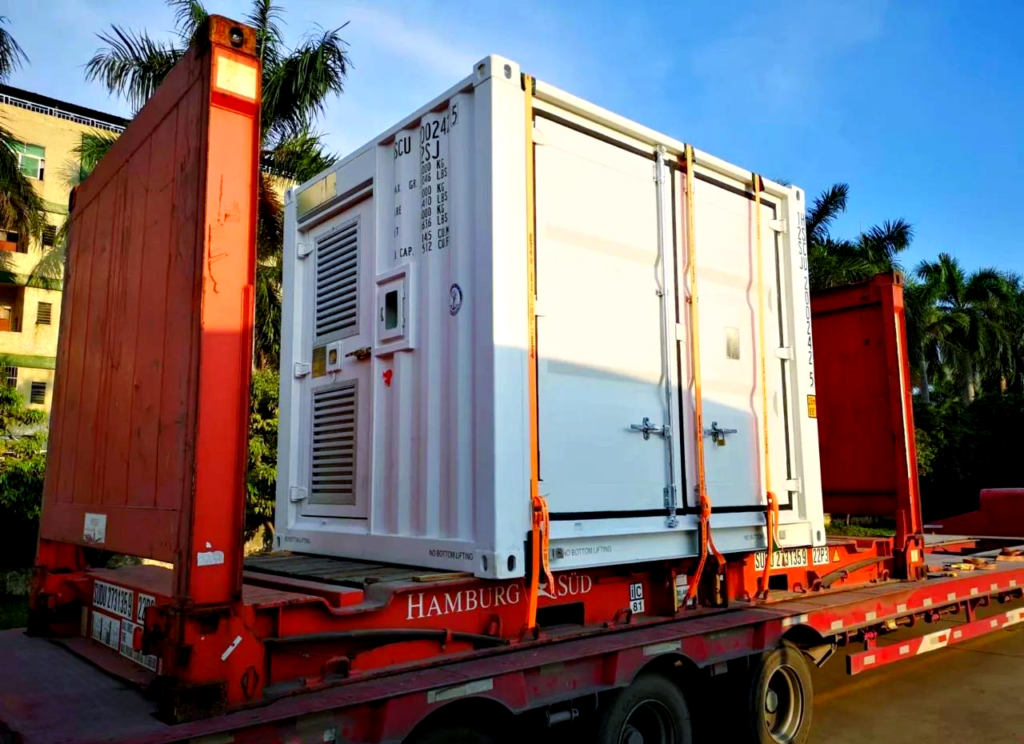
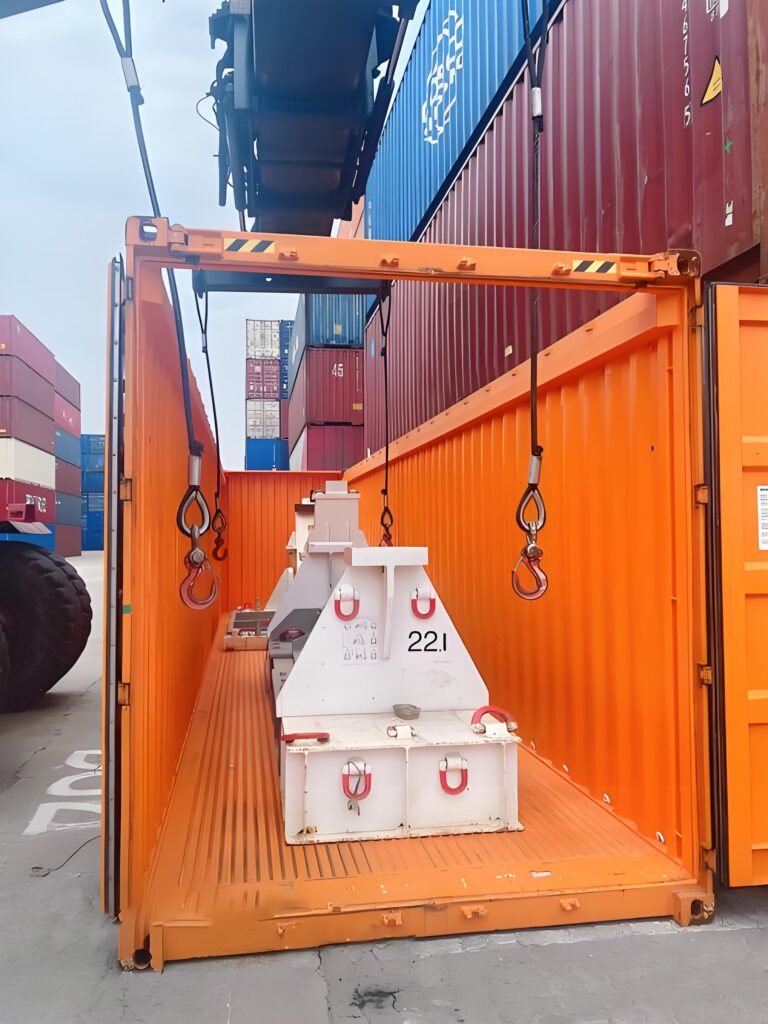
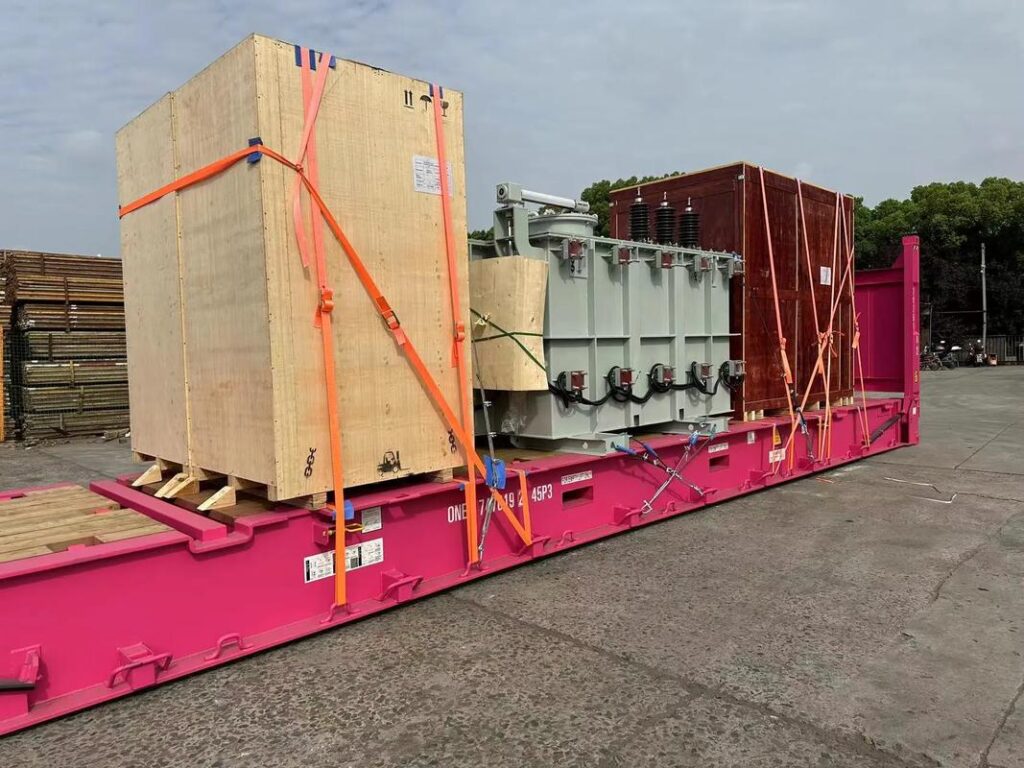
In the hierarchy of maritime logistics, standard containers are the simple arithmetic of the trade, while Out of Gauge (OOG) cargo is advanced calculus. When your shipment spans 3.2 meters in width, it fundamentally breaks the mold of conventional shipping. It cannot fit inside a standard dry container, and it cannot be treated as a passive box on a ship. Instead, it becomes a dynamic, wind-catching structure that must be married to the deck of a vessel. This article provides a deep dive into the engineering and costing of a lashing plan for a 3.2m wide cargo, transforming a seemingly impossible shipment into a bankable, insurable asset.
The Geometry of the Problem: Why 3.2m Changes Everything
A standard 40-foot Flat Rack (40’FR) has an internal width of approximately 2.43 meters. At 3.2 meters, your cargo is 77 centimeters wider than the platform it sits on. This creates a “cantilever effect,” where the weight extends beyond the support structure. This triggers three immediate challenges:
- Overhang Liability: The cargo will protrude over the edges of the Flat Rack. This requires specific “Overhang Permits” and dictates which slot on the vessel the cargo can occupy (usually top-tier or on-deck where it won’t crush other containers).
- Wind Surface Area: At 3.2m wide, the cargo acts as a sail. In a Beaufort Force 9 storm (41-47 knots), the lateral wind pressure on a 3.2m wide object can generate forces exceeding 10-15 tons. Your lashing plan must counteract this.
- Center of Gravity (CoG): With the weight distributed over a wider area, the CoG shifts. If the CoG is high, the risk of toppling during vessel rolling increases exponentially.
Deconstructing the Lashing Plan: A Technical Blueprint
A professional lashing plan for a 3.2m wide load is not a sketch; it is a technical drawing backed by physics calculations. Here is what a competent forwarder or marine surveyor will provide:
1. The Bedding and Chocking Strategy
You cannot place a wide, heavy object directly onto the steel ribs of a Flat Rack.
- Timber Spacing: We use high-density hardwood beams (typically 10cm x 10cm) laid perpendicular to the Flat Rack’s floor beams. This distributes the load and prevents point-pressure damage.
- Side Chocking: Since the cargo is wider than the rack, we must prevent lateral movement. Triangular wooden chocks are fabricated to fit the exact curvature or profile of your cargo and are nailed or screwed to the Flat Rack deck.
2. The Lashing Calculation (The Math of Safety)
The plan must specify the number and type of lashings based on the Accelerations expected at sea.
- Transverse Force: Calculated as
Mass x Gravity x Heel Angle. For a 3.2m wide load, we assume a minimum heel angle of 25-30 degrees. - Lashing Angles: The optimal lashing angle is 30-45 degrees from horizontal. Too shallow, and the lashing pulls the cargo sideways; too steep, and it lacks tension.
- Material Specification: For a 3.2m wide industrial machine (assuming ~15-20 tons), we recommend Grade 80 Alloy Steel Chains with a minimum breaking strength of 10-13 tons per leg, secured with heavy-duty turnbuckles (rigging screws).
3. The “Stopper” Installation
Because the cargo overhangs, we often weld steel stoppers (heavy steel plates) to the Flat Rack deck at the four corners. This provides a physical barrier preventing the cargo from sliding off the platform during severe pitching.
The Quote: Deconstructing the Cost of Security
When requesting a quote for a 3.2m wide cargo from a port like Shanghai or Ningbo to a destination like Houston or Rotterdam, expect these specific line items:
| Cost Component | Description | Why it applies to 3.2m width |
|---|---|---|
| Base Ocean Freight | The cost of the slot on the vessel. | OOG cargo occupies 1.5 to 2 TEU slots. |
| OOG Surcharge | Premium for over-width cargo. | Tiered pricing (e.g., 3.0m-3.5m is Tier 3). |
| Lashing Supervision Fee | Marine surveyor attendance at stuffing. | Mandatory. The carrier will not accept the container without a signed lashing certificate. |
| Material Costs | Chains, turnbuckles, timber, welding rods. | Higher quantity needed due to increased width and leverage. |
| Terminal Handling (THC) | Port charges for heavy equipment. | Requires heavy-lift cranes for positioning. |
Operational Execution: The Stuffing Day
- Pre-Stuffing Survey: Before the cargo arrives at the port, the lashing plan must be approved by the carrier’s nautical department.
- The Welding: Steel stoppers are welded to the Flat Rack. This is done at the factory or a Container Freight Station (CFS) to save time at the terminal.
- The Lift: The cargo is lifted by crane and positioned precisely on the timber bedding.
- The Tensioning: Chains are attached to the cargo’s designated lashing points and tightened with hydraulic turnbuckles until they “sing” with tension.
- The Sign-Off: The marine surveyor checks every chain, every chock, and every weld. They issue the Certificate of Lashing. No certificate = No loading.
Risk Mitigation: The Insurance Imperative
Standard marine insurance often excludes “improper packing.” For a 3.2m wide load, you must have:
- All Risks Coverage: Explicitly covering OOG cargo.
- Lashing Failure Clause: Ensuring that if the chains break due to a certified plan, the insurance covers the damage to the cargo and the ship.
- Third-Party Liability: If the cargo shifts and damages adjacent containers on the ship, you are liable. Ensure your policy covers this.
Conclusion: Precision as a Service
Shipping a 3.2-meter wide cargo is not a commodity service; it is a project. The quote you receive should reflect the engineering hours, the quality of the materials, and the expertise of the supervision. By investing in a certified lashing plan, you are not just buying straps and wood; you are buying peace of mind and ensuring that your oversized asset survives the violent physics of the open ocean to arrive safely at its destination.
To provide you with a definitive quote and lashing plan, I need two more details:
- What is the total weight and length of the cargo?
- What is the origin port and destination port?
Provide these, and I can generate a preliminary technical specification for your shipment.


