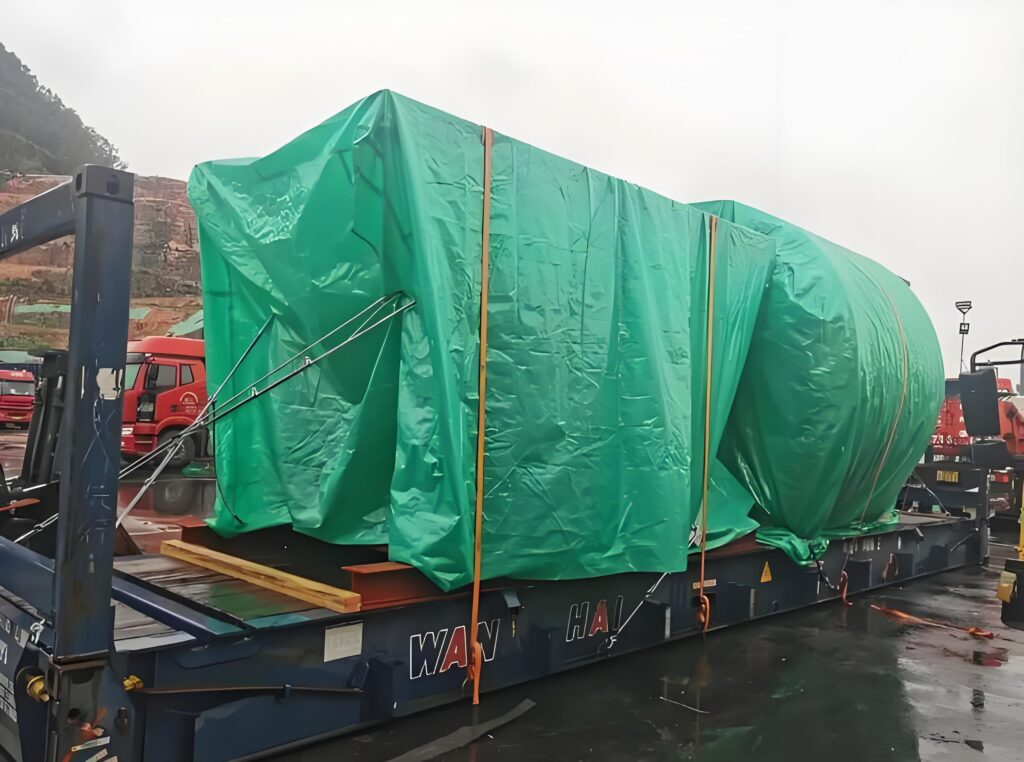
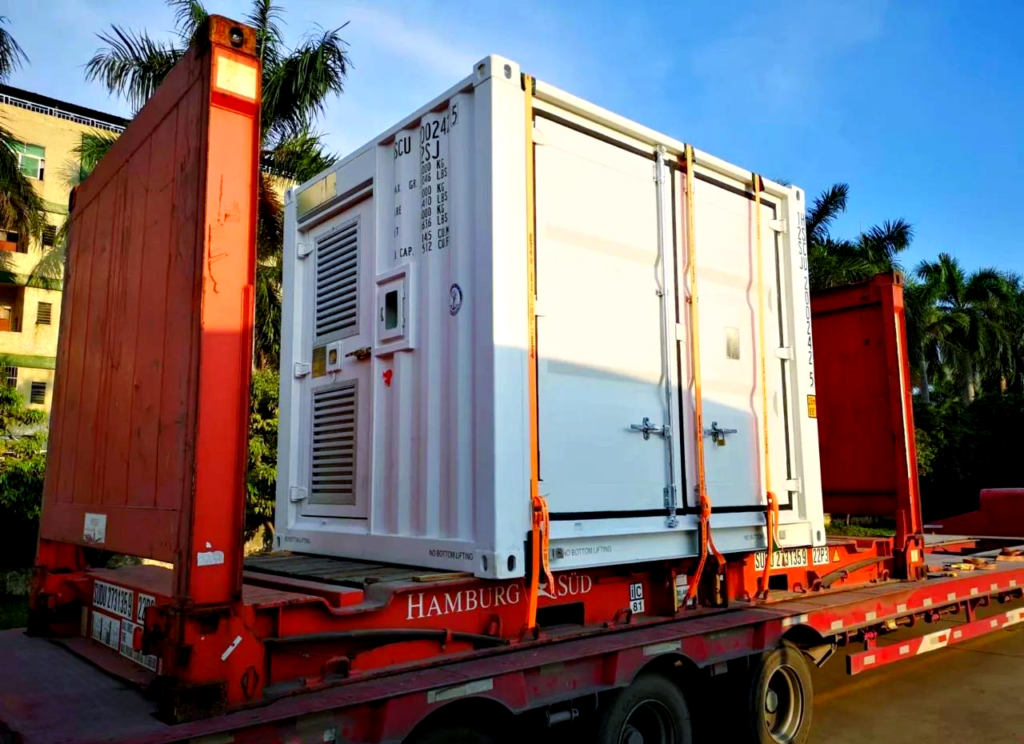
In the world of international logistics, there is a stark dividing line between moving boxes and moving mountains. When your shipment consists of a 150-ton hydro turbine, a 60-meter industrial boiler, or a precision CNC machine valued at millions of dollars, the conversation shifts from “logistics” to “structural engineering.” For exporters in China and importers worldwide, the greatest risk in specialized container shipping (特种柜海运) isn’t the ocean—it’s the failure of the cargo to stay put. This article focuses on the heart of heavy lift and oversized cargo transport: The Art and Science of Lashing and Securing. We will explore why a professional “One-Stop Service” from China must prioritize engineering over paperwork, and how the right securing plan is the only thing standing between a successful delivery and a total loss.
Chapter 1: The Invisible Force – Understanding the Physics of Motion
Many shippers make the fatal mistake of assuming that if a strap is tight, the cargo is safe. In reality, a container ship in the Pacific encounters waves that create angles of up to 30 degrees. This generates immense dynamic forces.
The Three Enemies of Stability
- Centrifugal Force: When a ship rolls, heavy cargo wants to slide sideways.
- Vertical Acceleration: As the ship plunges into a wave trough, the cargo becomes momentarily lighter; as it crests, the cargo slams down with multiplied force.
- Vibration: Engine vibrations can loosen improperly secured lashings over a 30-day voyage.
A professional lashing plan for a Flat Rack (FR) or Open Top (OT) shipment from Shanghai or Ningbo must account for the Center of Gravity (CoG). If the CoG is high, the cargo is prone to tipping. If it is low, it is stable. A true expert calculates the CoG before recommending the container type.
Chapter 2: The Arsenal of Restraint – Materials and Methods
Not all lashing materials are created equal. A reliable specialized forwarder in China uses a specific arsenal for different types of heavy cargo.
1. High-Tensile Steel Wire Ropes
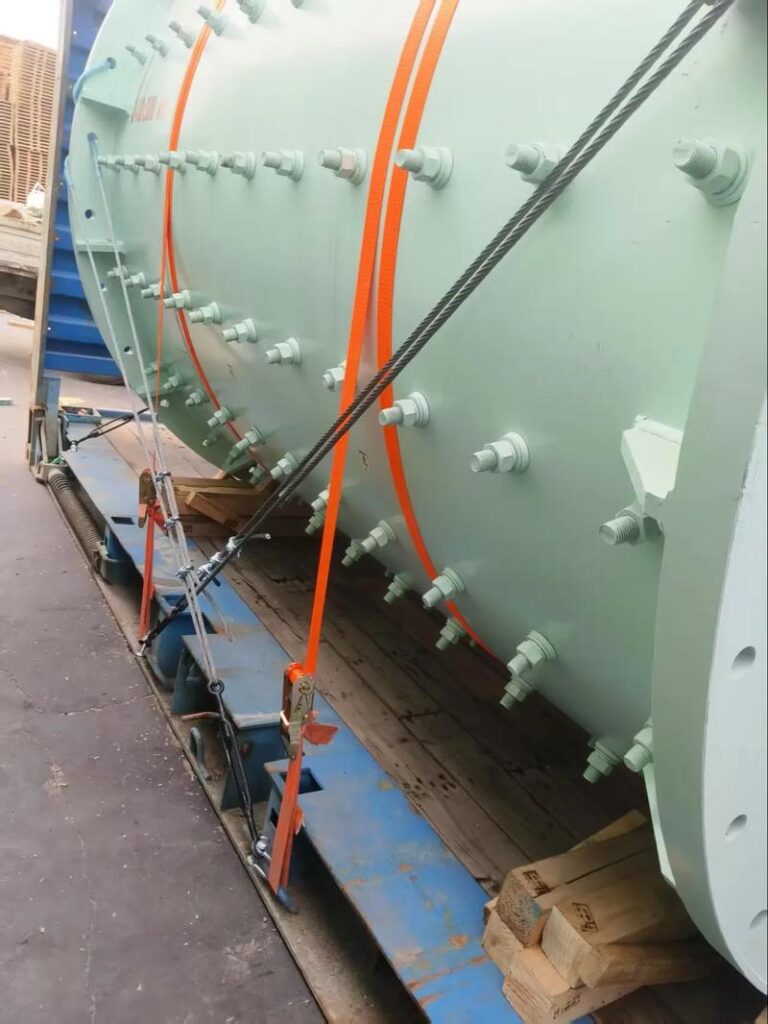
Used for the heaviest machinery (50+ tons). These ropes have minimal stretch, ensuring the cargo doesn’t shift under pressure. They are secured using Turnbuckles (rigging screws) to apply calculated tension.
2. Grade 80 Alloy Steel Chains
The gold standard for industrial equipment. Chains are durable and resistant to abrasion. Professionals use C-Hooks and J-Hooks to anchor the chain to the container’s lashing points. They never use “homemade” hooks.
3. Synthetic Webbing Straps (Ratchet Straps)
Used for finished goods or delicate surfaces where chains would cause damage. However, professionals know these have a high elongation rate (stretch). They are never used as the primary restraint for heavy lifts.
4. Dunnage and Chocking
Wood is not just filler; it is a structural component. Using kiln-dried hardwood, experts build custom chocks that fit snugly against the cargo’s tires or base. The nails used are not standard nails; they are ring-shank nails that resist pulling out under vibration.
Chapter 3: The Execution – From Factory Floor to Vessel Deck
Providing a “lashing service” means being present at every stage. It is not a “set and forget” operation.
Stage 1: The Pre-Loading Survey
Before the cargo arrives at the port of Shenzhen or Qingdao, an expert visits the factory. They photograph the load points on the machinery. They check if the factory has reinforced the base. If the machine has wheels, they ensure the brakes are functional. If the cargo is a transformer, they check for lifting lugs.
Stage 2: The Stuffing Supervision
This is where amateurs fail. A professional supervisor ensures:
- Symmetry: The cargo is centered on the Flat Rack. Uneven weight distribution can crack the container chassis.
- Angle of Lashing: The optimal angle for lashings is 30 to 60 degrees relative to the deck. Lashings that are too vertical or too horizontal are ineffective.
- Protection: Using corner protectors (rubber or plastic) to prevent the lashing material from cutting into the cargo.
Stage 3: The Seal of Approval
Once lashed, the supervisor takes high-resolution photos from multiple angles. These are sent to the shipping line for Pre-Stowage Approval. Without this approval, the terminal gate will reject the container, causing costly delays.
Chapter 4: Case Studies in Structural Integrity
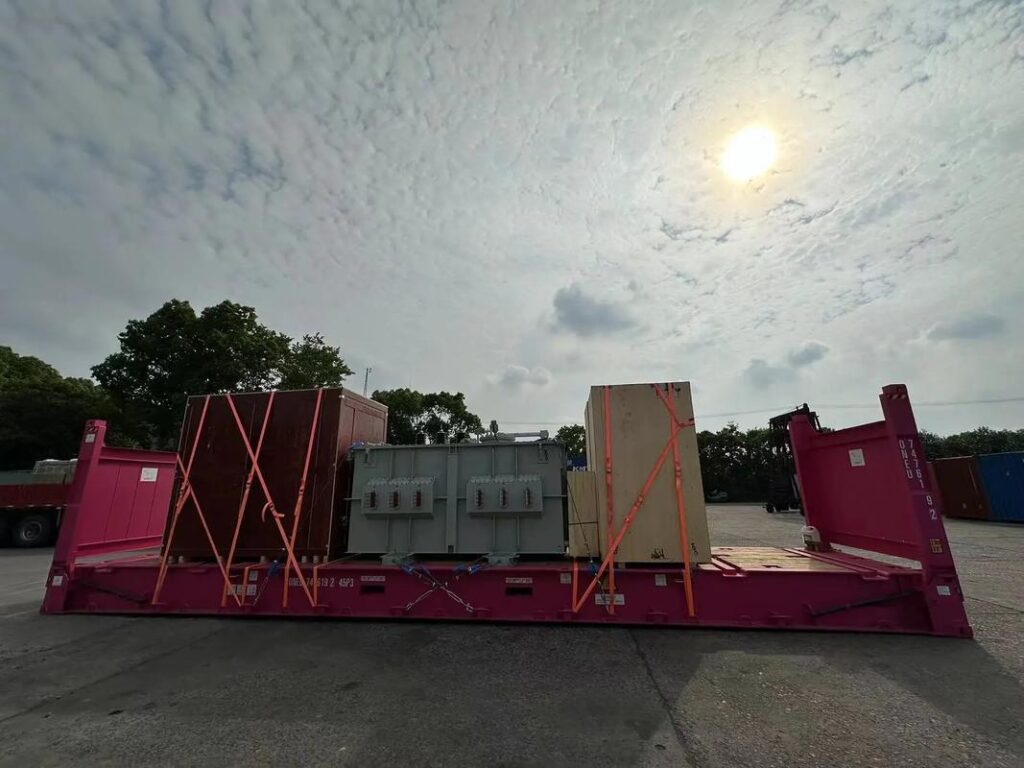
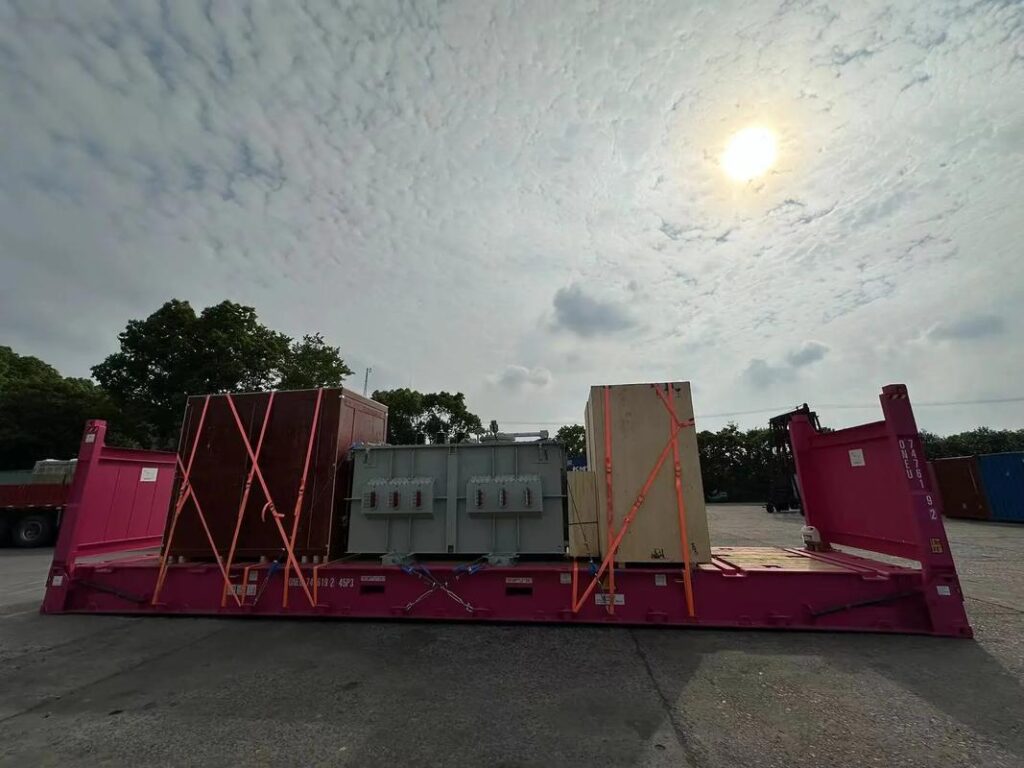
Case Study 1: The Power Transformer (Ningbo to Hamburg)
- Cargo: A 95-ton power transformer.
- The Challenge: The cargo’s center of gravity was high. Standard lashing would allow it to tip during heavy seas.
- The Expert Solution: Instead of just lashing down, the expert used Cross-Bracing. Steel wires were crisscrossed over the top of the transformer, creating a web that prevented lateral movement. Additionally, anti-tipping supports were welded to the base plate of the Flat Rack.
Case Study 2: The Construction Crane Boom (Tianjin to Los Angeles)
- Cargo: A 45-meter crane boom (Open Top).
- The Challenge: The length caused it to flex.
- The Expert Solution: The expert built a support cradle in the middle of the Open Top. This cradle supported the weight at the midpoint, preventing the boom from sagging and cracking during transport. The lashing focused on preventing the boom from rolling sideways.
Chapter 5: Why “One-Stop” Must Include Engineering
Many forwarders in China claim to offer “One-Stop Service.” However, if their stop doesn’t include a certified lashing engineer, it is incomplete. A true one-stop provider for heavy and oversized cargo from China offers:
- Engineering Calculation Sheets: Documented proof of the forces involved and how they are mitigated.
- Material Certification: Proof that the chains and wires meet ISO standards.
- On-Site Supervision: Physical presence during the stuffing process.
- Insurance Liaison: Ensuring the marine cargo insurance covers “Improper Stowage” (a common exclusion if lashing is subpar).
Chapter 6: The Future of Cargo Securing – Technology Integration
The industry is moving beyond ropes and wood. Leading experts in China are now using:
- 3D Laser Scanning: To create a digital twin of the cargo and simulate the lashing plan before the physical work begins.
- Load Sensors: Placing sensors on the lashings themselves to monitor tension in real-time during the voyage. If a strap loosens, an alert is sent to the forwarder and the consignee.
Conclusion: Don’t Ship Until It’s Secured
When you are shipping a standard consumer good, a delay is an inconvenience. When you are shipping a $2 million heavy machine from China, a failure is a catastrophe. The value of a specialized container expert is not measured by the freight rate they quote. It is measured by the certainty they provide that your asset will arrive exactly as it left. By focusing on professional-grade lashing, engineering-approved methods, and on-site supervision, you transform a risky venture into a predictable operation. Choose the partner who brings the toolbox, not just the booking sheet.
需


