Real Case Study: Shipping 3 Tons of Overweight Machinery to South Korea with Zero Damage and Express Clearanc
When it comes to shipping industrial machinery from China to South Korea, the stakes are incredibly high. You aren’t just moving boxes; you are moving millions of dollars in precision engineering.
Last month, we handled a project for a manufacturer in Guangdong who needed to export a 3-ton, high-precision CNC vertical machining center to a buyer in Changwon, South Korea, via Busan port. The shipment faced two major hurdles: it was highly vulnerable to moisture and physical shocks, and South Korea’s strict industrial safety regulations meant any compliance slip-up would freeze the machine at customs indefinitely.
Here is the exact step-by-step framework we used to ensure the cargo arrived in flawless condition and cleared South Korean customs in less than 24 hours.
The Step-by-Step Logistics Execution
- Pre-Clearance Audit & HS Code Alignment
Day 1–2
Before any wood was cut for crating, we aligned the 8-digit HS Code between China’s export manifest and the South Korean importer’s customs broker. Under the China-Korea Free Trade Agreement (CKFTA), accurate classification (Chapter 84) dropped the import tariff from a standard 8% down to 0%. We pre-verified the formal Certificate of Origin (Form K) to ensure it matched the Korean buyer’s import declaration exactly. - Verifying KCs / KC Certification Compliance
Day 3–4
Industrial machinery entering Korea is subject to the KCs Safety Certification governed by the Korea Occupational Safety and Health Agency (KOSHA). Because our client’s machinery fell under the “Safety Confirmation” (Type II) category, we worked with the buyer to ensure their registration numbers and technical data sheets were uploaded into the Korea Customs UNI-PASS system prior to departure. Attempting to ship without these pre-linked documents triggers immediate port detention. - Industrial Packing & Shock Mitigation
Day 5
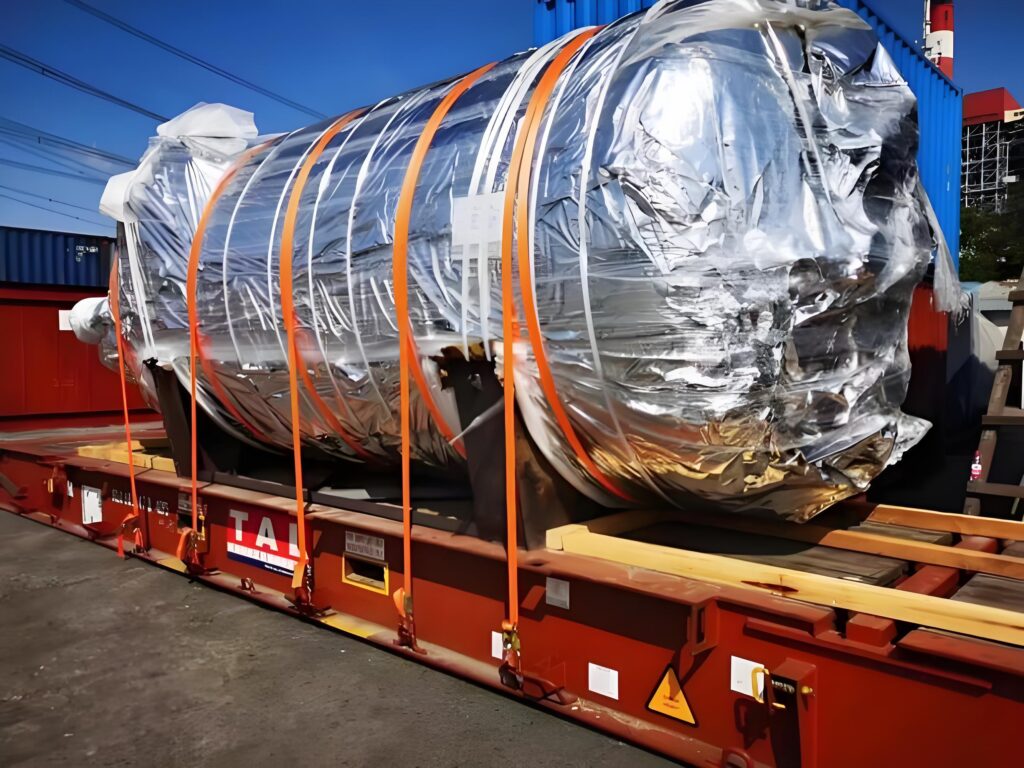
Weight concentrated in a heavy machine can easily break standard pallets. We designed a custom heavy-duty steel-reinforced wooden base. The machine was wrapped in anti-static VCI (Vapor Corrosion Inhibitor) film, vacuum-sealed to prevent salty sea-air rust, and secured in a solid wooden crate meeting ISPM 15 fumigation standards. Crucially, we attached ShockWatch indicators to the outside of the crate to visually log any rough handling by port cranes. - Securing the Open-Top Container (FCL)
Day 6
Because of its 3-ton weight and top-heavy dimensions, a standard dry van container wouldn’t allow crane loading. We booked a 20-foot Open-Top (OT) container out of Shenzhen port. Our heavy-lift team used heavy-duty ratchet straps, steel chains, and wooden chocks to secure the machine base directly to the container’s D-rings, ensuring zero shifting during rough waves in the East China Sea. - Fast-Track Customs Clearance at Busan Port
Day 9
The vessel arrived at Busan Port after a 4-day voyage. Because we utilized South Korea’s priority processing channel for compliant industrial machinery and pre-filed the KCs certification data, the electronic customs clearance went through a “Green Channel.” The customs declaration was approved within 4 hours of docking, completely bypassing physical inspection and saving the client hundreds of dollars in port storage fees.
3 Critical Takeaways from this Case Study
If you are preparation to ship heavy machinery or sensitive equipment to South Korea, keep these three rules in mind to protect your cargo and your wallet:
1. Wood Packing Without a Stamp Means Immediate Rejection
South Korea takes plant quarantine extremely seriously. Any solid wood packaging material (crates, pallets, dunnage) used to brace your machinery must bear the official IPPC symbol and a valid country code (e.g., CN for China) indicating it has been heat-treated. If customs inspectors spot even a single un-stamped piece of raw timber inside your container, they will lock down the entire shipment for mandatory fumigation or order an immediate return to origin.
2. KCs Certification for Machinery is Not Consumer “KC”
Many exporters confuse the standard consumer product KC mark with the industrial KCs mark.
The Difference: The KCs mark specifically targets factory machinery (robots, injection molders, milling lines) to protect local worker safety. It requires a deep dive into electrical circuit schematics and component test reports. Always ensure your buyer has cleared the KOSHA verification before you book ocean space.
3. Account for Port-to-Factory Inland Heavy Hauling
A 3-ton open-top container cannot be hauled by a standard container chassis in Korea due to local axle weight limitations and low-clearance bridges. We pre-booked a specialized low-bed trailer (low-boy) in Busan to transport the container directly to the client’s manufacturing facility in Changwon, avoiding unexpected transloading delays.
By combining flawless physical protection with meticulous regulatory pre-checks, this high-value shipment transitioned seamlessly from a factory floor in China to an operational production line in South Korea with zero damage and maximum tax savings.


